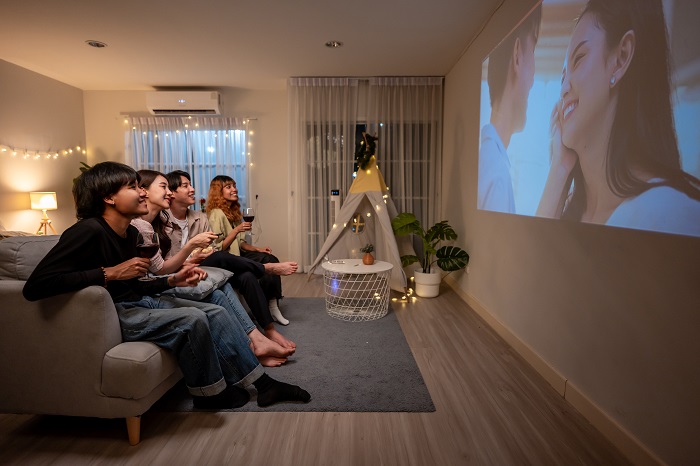
When selecting a projector, one of the most critical factors to consider is the space in which it will be used. The best projectors for small spaces differ significantly from those designed for large theaters, and understanding these differences is essential to making an informed purchase. Whether you need a compact unit for a cozy living room or a high-performance system for a full-scale home theater, choosing the right projector can elevate your viewing experience. In this article, we’ll explore the best projectors for small spaces versus large theaters, discussing key features, specifications, and recommendations tailored to each environment.
Projectors for Small Spaces
Small spaces such as apartments, dorm rooms, or compact living rooms require projectors with specific features that optimize performance in limited areas. The main factors to consider include throw ratio, brightness, resolution, and connectivity options.
Short Throw and Ultra-Short Throw Projectors
A crucial feature for projectors in small spaces is a short throw or ultra-short throw (UST) lens. These projectors can produce large images from a short distance, making them ideal for confined areas. Traditional projectors require significant distance to project a sizable screen, but short throw models can deliver a 100-inch display from just a few feet away.
Recommended models include the Optoma GT1080HDR, which offers Full HD resolution and a 120-inch image from just four feet away, and the Epson EpiqVision Ultra LS500, a UST projector with 4K resolution and a laser light source, great for bright environments and small spaces. These projectors reduce the need for extensive mounting and setup, making them convenient choices for renters or those who frequently rearrange their living spaces.
Brightness and Resolution Considerations
In small spaces, ambient lighting can impact image quality. Projectors with a brightness range of 1,500 to 3,000 lumens are generally sufficient for a standard living room. Additionally, a resolution of at least 1080p ensures a crisp and clear image for movie watching and gaming.
Some great options include the BenQ HT2050A, a budget-friendly 1080p projector with 2,200 lumens and excellent color accuracy, and the Anker Nebula Cosmos Max, a 4K HDR projector with 1,500 lumens, offering great visuals in dimly lit rooms. A higher resolution ensures that even in smaller spaces, images remain detailed and immersive, particularly for those who enjoy streaming high-definition content or gaming.
Portability and Compact Design
Many people using projectors in small spaces may need to move them frequently. Compact, lightweight models with built-in speakers and wireless connectivity are convenient for easy setup and mobility.
The ViewSonic M1+ is a highly portable, battery-powered projector with Bluetooth audio and a compact design, while the XGIMI Horizon Pro is a 4K compact projector with auto-focus and AI-driven image correction for easy setup. Some models also include automatic keystone correction, ensuring that the image remains properly aligned even if the projector is placed at an angle.
Projectors for Large Theaters
For dedicated home theaters or large venues, the requirements for projectors change significantly. High brightness, superior resolution, advanced image processing, and robust audio connectivity are essential to creating an immersive cinematic experience.
High Lumen Output for Large Screens
Large theater setups require projectors with higher brightness levels to project sharp images on big screens. A projector with at least 3,500 lumens is recommended to combat ambient light and ensure clarity across a larger display.
Some recommended models include the Sony VPL-XW7000ES, a premium 4K laser projector with 3,200 lumens and exceptional HDR performance, and the Epson Pro Cinema LS12000, a 4K laser projector offering 2,700 lumens and high contrast for home theater setups. These models are designed to deliver professional-grade image clarity, ensuring that even in rooms with ambient lighting, the picture remains vivid and detailed.
Resolution and HDR Performance

For a truly cinematic experience, 4K resolution with high dynamic range (HDR) support is ideal. HDR enhances color depth and contrast, making visuals more vibrant and lifelike. For larger screens, the additional detail and color accuracy of 4K or even 8K resolution can dramatically enhance the viewing experience.
Top choices include the JVC DLA-NZ8, a high-end 8K e-shift projector with high contrast, deep blacks, and exceptional color accuracy, and the LG HU810PW, a 4K laser projector with HDR10 and HLG support for stunning picture quality. These models cater to cinephiles and professional home theater enthusiasts looking for the highest-quality visuals.
Advanced Image Processing and Connectivity
Large theaters often require projectors with advanced image processing capabilities, including motion interpolation and dynamic tone mapping. Additionally, robust connectivity options, including HDMI, eARC, and networking capabilities, allow for seamless integration into home theater systems.
Some top picks are the BenQ HT5550, a 4K HDR projector with cinematic color accuracy and lens shift for flexible installation, and the Christie 4K10-HS, a high-performance 4K projector designed for professional cinema-quality visuals. These models also feature high frame rate support, making them excellent choices for gaming and action-packed films.
Key Differences Between Small Space and Large Theater Projectors
One of the most significant differences between projectors for small spaces and large theaters is the throw distance. Small spaces benefit from short throw and ultra-short throw projectors, while large theaters require standard or long-throw projectors. Brightness is another major factor, as small spaces typically need 1,500 to 3,000 lumens, whereas large theaters require 3,500 lumens or more to maintain image clarity on bigger screens.
Resolution also plays a crucial role. While 1080p to 4K is sufficient for small spaces, large theaters demand higher resolutions, such as 4K or even 8K, to ensure maximum clarity. Portability is a key advantage of projectors for small spaces, making them easy to move and set up, whereas large theater projectors are designed for permanent installations. Additionally, small space projectors often include built-in speakers or support for soundbars, while large theater setups require external audio systems to deliver full surround sound experiences.
Another significant consideration is cost. Small-space projectors are typically more affordable, with entry-level models available for a few hundred dollars. Large theater projectors, on the other hand, can be a significant investment, with high-end models costing several thousand dollars. However, the difference in image quality and immersive experience often justifies the expense for dedicated home theater enthusiasts.
Conclusion
Choosing the right projector depends on your space and viewing preferences. For small spaces, short throw or ultra-short throw projectors with moderate brightness and resolution are ideal, offering compact, portable solutions. In contrast, large theaters require high-lumen projectors with 4K or 8K resolution, advanced image processing, and external audio integration to create a true cinematic experience
Leave a Reply